
Breed-Specific Dog Health and Nutrition: How to Feed Your Dog Based on Their Breed
Quick answer: Your dog’s breed shapes how she should eat. Size determines calorie density and portion size, deep-chested breeds need slow, split meals to lower bloat risk, and breeds like Miniature Schnauzers, Dalmatians, and Labradors carry genetic quirks that change what belongs in the bowl. Start with your dog’s size tier below, then check the breed-specific table for conditions that apply to your dog.
Walk down any pet store aisle and you will see food marketed “for Labs” or “for small breeds,” and it is fair to wonder how much of that is science and how much is shelf appeal. The honest answer: some of both. There is no magic kibble formula unique to a Beagle. But breed genuinely does influence metabolism, growth rate, jaw size, and disease risk, and feeding with those factors in mind is one of the highest-impact things you can do for your dog’s long-term health.
This guide covers the three things that actually matter: your dog’s size tier, her breed’s known health predispositions, and how to handle homemade food safely if you want to go that route.
Why breed matters more than the marketing suggests
Three real, evidence-backed reasons breed changes feeding decisions:
- Growth rate. A Great Dane puppy grows roughly 100-fold from birth to adulthood. Feed her a calcium-rich small-breed puppy formula and you raise her risk of developmental orthopedic disease. Large-breed puppy food exists for a documented medical reason, not a marketing one.
- Metabolism and body composition. Toy breeds burn calories fast relative to body weight and can develop hypoglycemia if meals are skipped. Meanwhile, Cambridge researchers identified a 14 base pair deletion in the POMC gene that is more common in Labradors and closely related Flat-Coated Retrievers, and that is associated with higher body weight, more body fat, and stronger food motivation. That is why your Lab acts starving twenty minutes after dinner. She is not lying to you. Her brain genuinely never got the memo.
- Inherited disease risk. Certain breeds metabolize fat, purines, or copper differently, and diet is a frontline management tool for those conditions.
Step 1: Feed by size tier
Toy and small breeds (under 20 lbs)
Small dogs need calorie-dense food in small kibble sizes their jaws can manage. Puppies of toy breeds like Yorkies and Chihuahuas should eat three to four small meals a day to prevent blood sugar crashes. Dental disease is rampant in small breeds, so kibble texture and daily dental care matter more here than in any other tier.
Medium breeds (20 to 50 lbs)
The most forgiving tier. Standard adult formulas fit most medium dogs well. Your main job is portion control and adjusting for activity level, since a couch-loving Bulldog and a field-bred Springer Spaniel at the same weight can have wildly different calorie needs.
Large and giant breeds (50 lbs and up)
Two non-negotiables. First, large-breed puppies must eat a large-breed puppy formula with controlled calcium and calories until they reach skeletal maturity, which can take 18 to 24 months in giant breeds. Slow growth builds sound joints. Second, keep adult large breeds lean. In a landmark 14-year paired feeding study, Purina researchers raised 48 Labrador Retrievers in pairs, feeding one dog in each pair 25 percent less than its littermate from eight weeks of age until death. The restricted dogs lived a median of roughly two years longer and showed signs of chronic disease later in life. Lean is the cheapest longevity intervention that exists.
Step 2: Check your breed’s specific risks
| Breed / group | Dietary concern | What to do |
|---|---|---|
| Miniature Schnauzer | Prone to high blood triglycerides and pancreatitis | Choose lower-fat foods, skip fatty table scraps entirely, and ask your vet about lipid screening |
| Dalmatian | Unique purine metabolism causes urate bladder stones | Low-purine diet: limit organ meats and game, encourage constant water access |
| Labrador Retriever | POMC mutation drives relentless appetite and obesity | Measure every meal with a gram scale, use veggies like green beans as low-calorie filler, treat from the daily ration |
| Great Dane, Standard Poodle, Weimaraner, other deep-chested breeds | Bloat (GDV), a life-threatening emergency | Split food into 2 to 3 meals, use a slow feeder, avoid intense exercise right after eating, discuss preventive gastropexy with your vet |
| Bedlington Terrier, some Labs and Dobermans | Copper storage disease affecting the liver | If diagnosed, your vet will prescribe a low-copper therapeutic diet |
| Golden Retriever, other breeds with DCM concern | Possible link between certain grain-free, legume-heavy diets and heart disease | Favor foods meeting WSAVA guidelines from companies with veterinary nutritionists on staff; grain-free is not automatically better |
| Yorkshire Terrier, Chihuahua (puppies) | Hypoglycemia from missed meals | Frequent small meals through the first months of life |
| Bulldogs, Frenchies, other brachycephalic breeds | Food sensitivities, skin issues, difficulty eating fast | Elimination diet under vet guidance for chronic itch or ear infections, shallow wide bowls for flat faces |
The full A to Z reference: 100 more breeds
The table above covers the highest-stakes, best-documented diet and disease links. The reference below goes breed by breed. For most breeds the guidance flows from size tier, body type, and known predispositions rather than a unique disease, and that is good news: it means the fundamentals in this guide already cover your dog. Where a breed has a documented diet-linked condition, it is noted. Breeds with a live guide on this site are linked.
| Breed | Dietary concern | What to do |
|---|---|---|
| A | ||
| Affenpinscher | Toy-breed dental disease | Small-bite kibble, daily dental care, measured meals |
| Afghan Hound | Deep chest raises bloat risk; naturally lean sighthound | Split meals, slow feeder, do not fatten a lean body type |
| Airedale Terrier | Skin allergies in some lines | Omega-3 support, elimination diet if chronic itch appears |
| Akbash | Giant livestock guardian growth | Large-breed puppy formula until skeletal maturity, keep lean |
| Akita | Bloat risk, thyroid and immune-mediated skin conditions | Split meals, slow feeder, vet workup for coat or skin changes |
| Alaskan Klee Kai | Small size, sometimes picky | Calorie-dense small-breed food, consistent mealtimes over grazing |
| Alaskan Malamute | Zinc-responsive dermatosis is documented in the breed | Vet visit for crusty facial skin lesions; never supplement zinc without guidance |
| American Bulldog | Joint stress from weight | Lean body condition, joint-support nutrients for seniors |
| American Eskimo Dog | Easy weight gain | Measured meals, treats under 10 percent of calories |
| American Foxhound | High working energy needs | Feed to activity level; a kenneled pet needs far less than a hunting dog |
| American Hairless Terrier | Exposed skin needs support | Omega-3 rich diet for skin barrier health |
| American Staffordshire Terrier | Food and environmental allergies are common | Elimination diet under vet guidance for chronic itch or ear trouble |
| Anatolian Shepherd | Giant growth plus deep chest | Large-breed puppy food, split adult meals, slow feeder |
| Appenzeller Sennenhund | Active working metabolism | Feed to condition, joint support as she ages |
| Australian Cattle Dog | Weight creep after activity drops | Recalculate portions whenever her exercise routine changes |
| Australian Kelpie | Very high calorie burn when working | Performance formula for working dogs, standard adult food for pets |
| Australian Shepherd | Easy keeper once neutered or less active | Measure meals, keep lean to protect hips |
| Australian Terrier | Elevated diabetes risk in the breed | Keep her lean lifelong; ask your vet about screening if drinking or urination increases |
| Azawakh | Extremely lean by design | Visible last ribs can be normal; judge condition by breed standard, not Lab standards |
| B | ||
| Basenji | Fanconi syndrome, a kidney disorder, occurs in the breed | Annual urine screening; if diagnosed, your vet will prescribe a specific protocol |
| Basset Hound | Obesity strains the long back; bloat risk despite short legs | Strict portion control, split meals, keep her lean |
| Beagle | One of the most obesity-prone breeds | Gram-scale portions, no free feeding ever, low-calorie training treats |
| Bearded Collie | Addison’s disease predisposition | Feed a lean active-herder diet; vet visit for vague GI signs plus lethargy |
| Beauceron | Deep-chested bloat risk | Two to three meals daily, rest after eating |
| Belgian Malinois | Elite athlete calorie demands | Performance nutrition for working dogs; pet Malinois still need measured portions |
| Belgian Sheepdog | Occasional sensitive stomachs | Consistent diet, slow transitions, keep lean |
| Belgian Tervuren | Same profile as its Belgian cousins | Feed to work level, slow food transitions |
| Bergamasco | Generally hardy | Standard large-breed feeding, lean condition under all that coat |
| Berger Picard | Generally hardy | Feed to condition; the tousled coat hides weight gain, so use your hands |
| Bernese Mountain Dog | High cancer rates and joint disease; every extra pound hurts | Large-breed puppy food, lifelong lean condition, joint support |
| Bichon Frise | Bladder stones and dental disease | Constant fresh water, frequent potty breaks, dental care, vet visit for straining |
| Black and Tan Coonhound | Deep chest, bloat risk | Split meals, no hard exercise around mealtimes |
| Black Russian Terrier | Giant-breed growth and hips | Large-breed puppy formula, slow steady growth, lean adult weight |
| Bloodhound | One of the highest bloat rates of any breed | Three smaller meals, slow feeder, discuss preventive gastropexy with your vet |
| Bluetick Coonhound | Working energy needs, bloat risk | Feed to activity, split meals, rest after eating |
| Boerboel | Giant growth, joint load | Controlled large-breed puppy feeding, strict lean condition |
| Border Collie | Burns enormous calories when working | Feed to output; a sport dog and a couch dog need very different portions |
| Border Terrier | Gluten-sensitive cramping syndrome (CECS) is documented in the breed | If episodes of cramping occur, ask your vet about a strict gluten-free trial |
| Borzoi | Deep-chested sighthound, bloat risk | Multiple small meals, calm after eating, lean is normal |
| Boston Terrier | Gulps air while eating, famously gassy | Slow feeder, highly digestible food, shallow bowl |
| Bouvier des Flandres | Bloat risk, joint load | Split meals, large-breed formulas, lean condition |
| Boxer | Breed-specific heart disease (ARVC); sensitive digestion | Avoid legume-heavy grain-free diets, ask your vet about heart screening, feed a consistent digestible diet |
| Boykin Spaniel | Active gundog needs, ear infections | Feed to activity; chronic ear trouble warrants a food-allergy conversation |
| Briard | Deep chest, bloat risk | Split meals, slow feeder, lean under the coat |
| Brittany | High field energy | Feed to work level, keep hunting-season and off-season portions separate |
| Brussels Griffon | Toy dental disease, flat-face eating difficulty | Small kibble, shallow wide bowl, daily dental care |
| Bull Terrier | Hereditary kidney disease and skin allergies in some lines | Ask your vet about kidney screening; elimination diet for chronic skin trouble |
| Bullmastiff | Giant growth, bloat risk | Large-breed puppy food to 18+ months, split adult meals |
| C | ||
| Cairn Terrier | Easy weight gain | Measured meals, active lifestyle, count the treats |
| Canaan Dog | Efficient primitive metabolism | She likely needs less food than the bag suggests; feed to condition |
| Cane Corso | Giant growth, bloat risk | Slow controlled puppy growth, split meals, strict lean weight |
| Cardigan Welsh Corgi | Long back plus easy weight gain | Lean condition is spine protection; measure everything |
| Carolina Dog | Efficient primitive metabolism | Modest portions, feed to condition |
| Catahoula Leopard Dog | Working calorie needs | Feed to job; pet Catahoulas gain weight on working-dog portions |
| Cavalier King Charles Spaniel | Mitral valve heart disease in most of the breed; obesity-prone | Lean weight protects the heart; follow your cardiologist’s diet advice once diagnosed |
| Central Asian Shepherd | Giant guardian growth | Large-breed puppy formula, slow growth, lean adulthood |
| Cesky Terrier | Gains weight very easily | Small measured meals, daily walks, minimal table food |
| Chesapeake Bay Retriever | Hardworking retriever, hip risk | Large-breed puppy food, lean condition, feed to swim and field workload |
| Chinese Crested | Severe dental disease, exposed skin | Soft or small kibble as teeth allow, daily dental care, omega-3s |
| Chinook | Sled-dog work capacity | Feed to activity level, standard large-breed care otherwise |
| Chow Chow | Thyroid issues, easy weight gain under heavy coat | Hands-on condition checks monthly, vet workup if weight climbs on normal portions |
| Clumber Spaniel | Heavyset build gains weight fast | Strict portions, lean condition to protect joints and back |
| Cockapoo | Ear infections, weight creep | Measured meals; recurring ear trouble merits a diet conversation with your vet |
| Cocker Spaniel | Chronic pancreatitis risk, food-linked ear and skin trouble, obesity | Moderate-fat diet, no fatty scraps, elimination trial for chronic ears |
| Collie | Generally hardy, easy keeper | Lean condition, measured meals under the full coat |
| Coonhound | Working energy, bloat in deep-chested individuals | Feed to activity, split meals, rest around mealtimes |
| Coton de Tulear | Toy dental disease | Small kibble, daily dental care |
| Curly-Coated Retriever | Deep chest, bloat risk | Split meals, lean condition, feed to field workload |
| D | ||
| Dachshund | Back disease (IVDD) where weight is the biggest controllable factor | Ruthlessly lean condition; every extra ounce loads the spine |
| Dandie Dinmont Terrier | Long low back | Lean weight, measured meals, discourage jumping after big meals |
| Danish-Swedish Farmdog | Generally hardy | Standard small-to-medium feeding, active lifestyle |
| Dogo Argentino | Large athletic build, joint load | Large-breed puppy food, lean muscular condition |
| Dogue de Bordeaux | Giant growth, heart disease, bloat | Slow puppy growth, split meals, ask your vet about cardiac screening |
| Dutch Shepherd | High working drive and burn | Performance feeding for working dogs, measured portions for pets |
| E | ||
| English Cocker Spaniel | Ear infections with food-allergy links, weight creep | Elimination diet for chronic ears, measured meals |
| English Foxhound | Pack-hound stamina needs | Feed to miles run; pet foxhounds need far smaller portions |
| English Setter | Thyroid issues, weight gain when under-exercised | Lean condition; vet workup if weight climbs on normal portions |
| English Springer Spaniel | Ear infections, field-versus-couch calorie gap | Feed to activity, address chronic ears with a diet conversation |
| English Toy Spaniel | Flat face, heart concerns, toy dental | Shallow bowl, small kibble, lean weight for the heart |
| Entlebucher Mountain Dog | Driven worker, joint load | Feed to output, keep lean for hips |
| Estrela Mountain Dog | Giant guardian growth | Large-breed puppy formula, slow growth, split adult meals |
| Eurasier | Thyroid issues, calm easy keeper | Modest portions; vet workup for unexplained weight gain or coat change |
| F | ||
| Field Spaniel | Thyroid issues, ear infections | Lean condition, ear checks, vet workup for weight or coat changes |
| Finnish Lapphund | Easy keeper under an Arctic coat | Measured meals, monthly hands-on rib checks |
| Finnish Spitz | Generally hardy | Standard feeding, lean active condition |
| Flat-Coated Retriever | Very high cancer rates; deep chest | Lifelong lean condition, split meals, prompt vet visits for appetite changes |
| G to Z highlights | ||
| German Shepherd | Sensitive digestion, exocrine pancreatic insufficiency (EPI) risk, bloat | Highly digestible consistent diet, split meals; ravenous appetite with weight loss needs an EPI test |
| German Shorthaired Pointer | Deep chest, athlete’s calorie needs | Split meals, rest after eating, feed to field workload |
| Great Pyrenees | Giant growth with a surprisingly slow metabolism | Large-breed puppy food, then smaller adult portions than her size suggests |
| Greyhound | Notorious dental disease, naturally lean build | Daily dental care, higher-calorie food for hard keepers, ribs showing slightly is normal |
| Havanese | Toy dental disease | Small kibble, daily brushing, measured meals |
| Irish Wolfhound | Giant growth, heart disease, bloat | Slow puppy growth to 24 months, split meals, cardiac screening per your vet |
| Jack Russell Terrier | Burns fuel fast, small-breed dental | Feed to her considerable activity, dental care daily |
| Leonberger | Giant growth, bloat risk | Large-breed puppy formula, controlled growth, split adult meals |
| Mastiff | Giant growth, bloat, weight-driven joint damage | Slow growth to 24 months, lean condition always, split meals |
| Newfoundland | Cystinuria (bladder stones) and taurine-linked heart disease documented | Constant water access, avoid legume-heavy grain-free diets, ask your vet about screening |
| Pembroke Welsh Corgi | Long back plus a champion appetite | Lean condition is non-negotiable for the spine; measure every meal |
| Pug | Among the most obesity-prone breeds, flat face | Strict portions, shallow bowl, slow feeder, low-calorie treats |
| Rottweiler | Joint disease and bone cancer risk; weight matters | Large-breed puppy food, lifelong lean muscular condition |
| Saint Bernard | Giant growth, bloat, joints | Slow controlled growth, split meals, lean condition |
| Samoyed | Elevated diabetes risk in the breed | Lean lifelong; increased thirst or urination warrants prompt screening |
| Shih Tzu | Bladder stones, dental disease, flat face | Fresh water always available, dental care, shallow bowl |
| Siberian Husky | Zinc-responsive dermatosis documented; famously efficient metabolism | She may need less food than expected; vet visit for crusty facial lesions, no DIY zinc |
| Vizsla | Lean athlete with big fuel needs | Feed to her running schedule, lean is her natural state |
| West Highland White Terrier | Skin allergies are the breed’s signature problem | Elimination diet under vet guidance, omega-3 support |
| Whippet | Naturally lean sighthound, dental disease | Do not overfeed to “fill her out”; daily dental care |
Find your breed’s full guide. Every breed guide on this site includes a health section covering the conditions above in more detail. Browse the A to Z breed directory to find yours.
The homemade food question, answered honestly
Homemade dog food is having a moment, and the appeal is real: you control every ingredient, which matters enormously for dogs with pancreatitis, urate stones, or food allergies. The catch is just as real, and the numbers are stark. When UC Davis researchers ran the largest nutritional evaluation of home-prepared dog food recipes ever conducted, they found that 95 percent of the 200 recipes they analyzed were short on at least one essential nutrient, and more than 83 percent had multiple deficiencies. Only four of those 200 recipes were written by board-certified veterinary nutritionists, and all four were adequate. A more recent analysis of 1,726 real home-prepared diets fed by Dog Aging Project participants reached the same conclusion: roughly 6 percent had the potential to be nutritionally complete.
The rule is simple: a homemade diet is only safe long-term if it is formulated or checked by a board-certified veterinary nutritionist, or built with a balancing supplement designed for the exact recipe. Services exist where a veterinary nutritionist will build a recipe around your dog’s breed, weight, and diagnoses. For a Schnauzer with pancreatitis or a Dalmatian with stone history, that consult is worth every penny.
A gentle, low-fat mix many vets suggest as a short-term bland diet, and a reasonable weekend topper for healthy adult dogs:
- 2 cups cooked skinless chicken breast or lean ground turkey, drained
- 2 cups cooked white rice or plain cooked sweet potato
- 1 cup steamed green beans or carrots, chopped
- 1 tablespoon plain canned pumpkin (not pie filling)
Cool fully, portion by your dog’s size, and refrigerate up to three days. As a permanent full diet this recipe is not complete: it lacks adequate calcium and several micronutrients and would need a veterinary balancing supplement to be fed daily.
Puppy-safe recipes: treats, toppers, and weaning gruel
Puppies are the group where homemade food goes wrong fastest. A growing skeleton needs calcium and phosphorus in a fairly narrow ratio, and a well-meaning bowl of chicken and rice supplies almost none of the calcium a bone-building puppy requires. Get it wrong for a few months and the result is not a vague deficiency, it is bowed legs, fractures, and permanent joint damage.
Why there is no complete homemade puppy dinner below. Every recipe here is a treat, a topper, or weaning food, and each is meant to sit alongside a complete commercial puppy food rather than replace it. If you want to feed your puppy a fully homemade diet, that recipe has to come from a board-certified veterinary nutritionist who has your specific puppy’s breed, age, and projected adult weight. Nothing else is safe for a growing dog.
Keep the same 10 percent ceiling for treats that applies to adult dogs, and remember that a 12-week Yorkie’s entire treat budget is a few crumbs. Cut everything smaller than you think you need to.
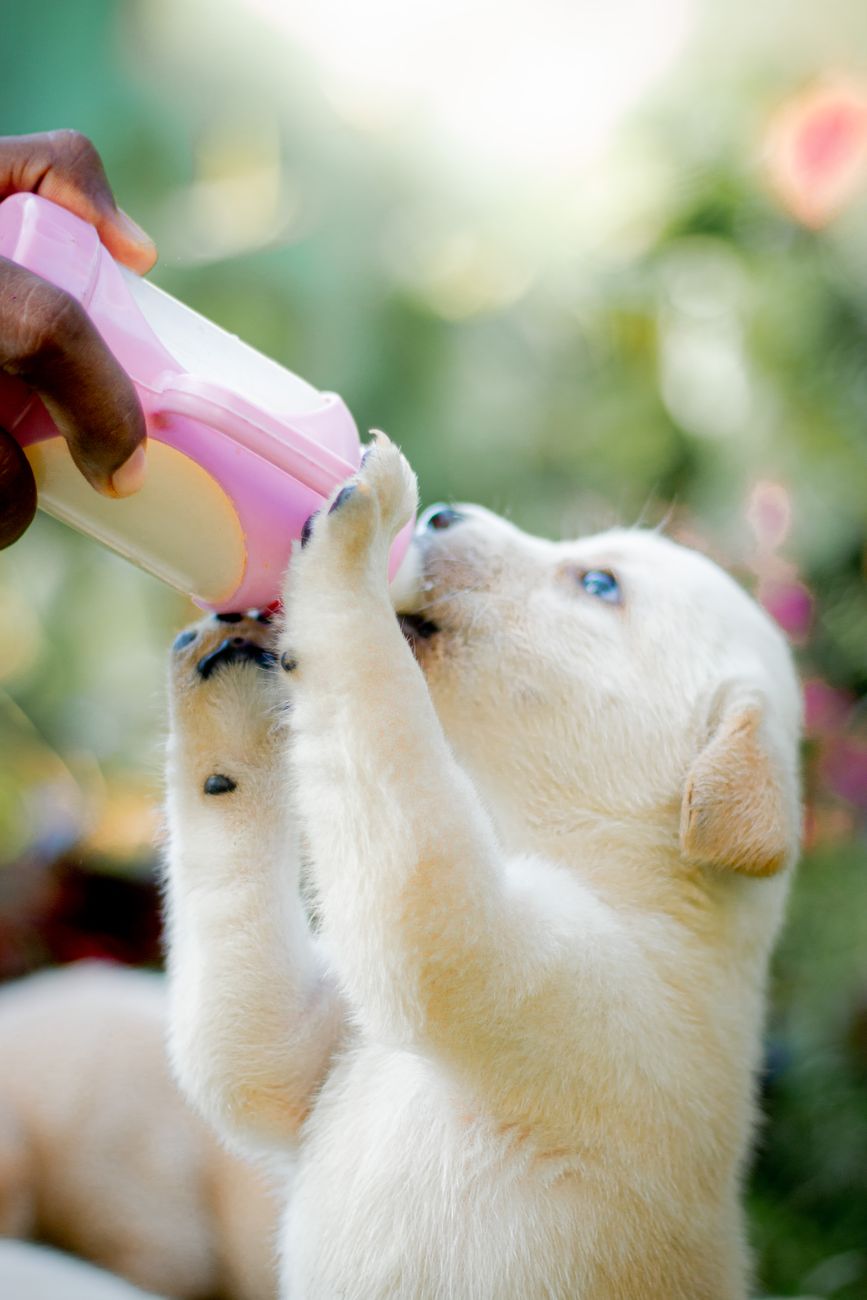
The standard first solid food, used by breeders to bridge from nursing to kibble. Puppies should still be nursing or bottle feeding through this stage.
- 1 cup complete puppy kibble
- 1.5 cups warm puppy milk replacer, or warm water if replacer is unavailable
Soak the kibble in the warm liquid for 15 to 20 minutes until fully soft, then blend or mash to a thin oatmeal texture. Serve at body temperature in a shallow dish, four to five times a day. Over the next two weeks, use less liquid each day until the puppies are eating softened kibble, then dry.
Storage: make it fresh each feeding. Discard anything left after 30 minutes.
Training a puppy means dozens of rewards an hour, so the reward has to be very small and very low calorie.
- 1 cup oat flour (or rolled oats blitzed in a blender)
- 1 large egg
- 1/3 cup plain canned pumpkin (not pie filling)
Heat the oven to 350°F. Mix to a stiff dough, adding a teaspoon of water at a time if it is too dry. Press flat to about 1/4 inch on a lined baking sheet and score into pea-sized squares. Bake 18 to 22 minutes until firm, cool completely, then break along the scores.
Storage: one week airtight at room temperature, or three months frozen.
Teething runs roughly from 12 weeks to 6 months and genuinely hurts. Cold helps.
- 1 cup plain unsweetened yogurt or plain kefir
- 1/2 cup plain canned pumpkin, or 1 mashed ripe banana
Stir together, spoon into a silicone ice cube tray, and freeze at least four hours. Offer one at a time on a washable floor. Use small cube sizes for small breeds.
Check first: some puppies do not tolerate dairy well. Try a teaspoon of the yogurt on its own and wait a day before making a full batch.
Simple and popular, with one non-negotiable safety step.
- 1/2 cup xylitol-free peanut butter, unsalted and unsweetened
- 1 ripe banana
- 1/2 cup water or plain unsweetened yogurt
Blend smooth, pour into a silicone tray or a rubber stuffable toy, and freeze until solid.
Check the label every single time. Xylitol, sometimes listed as birch sugar, appears in many sugar-free peanut butters and is life-threateningly toxic to dogs even in small amounts. Brands reformulate without warning, so read the jar you actually bought.
A chewy single-ingredient alternative to commercial chews, useful for puppies past the softest teething stage.
- 2 medium sweet potatoes, scrubbed
Heat the oven to 250°F. Slice lengthwise about 1/3 inch thick, arrange on a lined sheet without overlapping, and bake 2.5 to 3 hours, flipping halfway, until leathery but still flexible. Cool completely.
Storage: two weeks refrigerated, or freeze. Supervise chewing, and take away any piece small enough to swallow whole.
Useful for a nervous new puppy who is off her food in a strange house, and for softening kibble during weaning.
- 2 lbs raw beef or chicken bones
- Water to cover by two inches
- 1 tablespoon apple cider vinegar
Simmer very low for 12 to 24 hours. Cool, skim the fat off the top, and strain out every bone before serving. Spoon a tablespoon or two over her regular food.
No onion, no garlic, no salt, no bouillon cubes. Store-bought broths almost always contain onion or high sodium, so read the label or make your own. Discard all cooked bones, which splinter.
One food at a time. Introduce a single new treat and wait two days before trying another. If something causes loose stool, vomiting, or itching, you will know exactly which one, and your vet will thank you for the clean history.
How much to feed: the two-week test
Bag labels are a starting guess, not gospel, and they routinely overestimate for spayed, neutered, and less active dogs. A better method:
- Start at the low end of the label range for your dog’s target weight, not her current weight if she is heavy.
- Weigh her every two weeks on the same scale.
- Run your hands over her ribs. You should feel them easily under a thin layer, like the back of your hand. If you have to press, feed less. If they are sharp and visible, feed more.
- Count treats. They should stay under 10 percent of daily calories, and for a Lab, subtract them from dinner.
Switching foods without upsetting her stomach
Almost every digestive upset blamed on a new food is really a switch made too fast. Her gut bacteria need time to adjust to a different ingredient and fat profile, so replace the old food gradually rather than swapping bowls overnight.
If she refuses the new food, resist the urge to top it with something tasty, which teaches her that holding out works. Warm the food slightly instead, or go back a step and move more slowly.
Frequently asked questions
Is breed-specific commercial dog food worth buying?
Sometimes. Formulas that adjust kibble shape for flat-faced breeds or fat levels for pancreatitis-prone breeds have genuine logic behind them. But a high-quality food matched to your dog’s size tier and life stage covers most of the benefit. The breed label matters far less than the size tier, the life stage, and keeping your dog lean.
Should my dog eat grain-free food?
Not unless a vet has diagnosed a grain allergy, which is rare. Grain allergies are far less common than protein allergies in dogs. In 2018 the FDA opened an investigation into reports of dilated cardiomyopathy in dogs eating diets high in peas, lentils, other legume seeds, and potatoes, many of them labeled grain-free. The agency has since said it does not have enough data to establish causality and stopped issuing routine updates at the end of 2022, so this is an open question rather than a settled one. Veterinary cardiologists generally advise caution with pulse-heavy formulas, especially for breeds already predisposed to heart disease. Grains like rice and oats are perfectly healthy for most dogs.
How do I switch my dog to a new food?
Transition over 7 to 10 days, gradually increasing the new food’s share of each meal. Deep-chested and sensitive-stomach breeds do best with the slowest transitions. Loose stool means slow down a step, not abandon ship.
Can I feed my dog a raw diet?
Raw feeding carries documented bacterial risks for both dogs and the humans in the household, and most homemade raw diets share the same nutritional gaps as homemade cooked ones. If you are committed to raw, work with a veterinary nutritionist and be rigorous about food handling. For households with kids, elderly members, or anyone immunocompromised, most vets advise against it.
My puppy is a large breed. When does she switch to adult food?
When she reaches skeletal maturity, which is around 12 months for most large breeds and up to 18 to 24 months for giants like Great Danes and Mastiffs. Ask your vet to confirm based on her growth. Switching early is far less risky than feeding a regular puppy formula that was never right for her in the first place.
Sources and further reading
- Kealy RD, Lawler DF, Ballam JM, et al. Effects of diet restriction on life span and age-related changes in dogs. Journal of the American Veterinary Medical Association, 2002;220(9):1315-1320. The 14-year paired feeding study of 48 Labrador Retrievers behind the lean-body-condition longevity finding.
- Lawler DF, Larson BT, Ballam JM, et al. Diet restriction and ageing in the dog: major observations over two decades. British Journal of Nutrition, 2008;99(4):793-805. The long-view follow-up analysis of the same cohort.
- Raffan E, Dennis RJ, O’Donovan CJ, et al. A deletion in the canine POMC gene is associated with weight and appetite in obesity-prone Labrador Retriever dogs. Cell Metabolism, 2016;23(5):893-900. The original University of Cambridge research identifying the appetite gene variant in Labradors and Flat-Coated Retrievers.
- University of Cambridge. Genetic variant may help explain why Labradors are prone to obesity. Plain-language summary of the POMC findings from the research team’s own institution.
- Stockman J, Fascetti AJ, Kass PH, Larsen JA. Evaluation of recipes of home-prepared maintenance diets for dogs. Journal of the American Veterinary Medical Association, 2013;242(11):1500-1505, listed among RCVS Knowledge’s evidence resources on unconventional diets. The 200-recipe analysis charted above.
- UC Davis. Homemade dog food recipes can be risky business, study finds. The university’s summary of the recipe study, including the finding that rotating recipes does not fix shared deficiencies.
- PetfoodIndustry. Study finds 94% of homemade dog diets lack complete nutrition. Coverage of the Dog Aging Project analysis of 1,726 real home-prepared diets by Texas A&M and Virginia Tech researchers.
- U.S. Food and Drug Administration. FDA investigation into potential link between certain diets and canine dilated cardiomyopathy. The primary source on the DCM investigation and its scope.
- American Veterinary Medical Association. FDA will end public updates on potential link between certain diets and canine dilated cardiomyopathy. Explains why the investigation stalled and what remains unresolved.
- Tufts University Cummings Veterinary Medical Center. Diet-associated dilated cardiomyopathy: the cause is not yet known but it hasn’t gone away. A veterinary nutrition team’s argument that pulses, not the absence of grain, are the more likely common thread.
- American Kennel Club. Diet-associated dilated cardiomyopathy: 2023 update. Breed-level breakdown of the DCM case reports submitted to the FDA.
This article is for general education and is not a substitute for veterinary advice. Always consult your veterinarian before changing your dog’s diet, especially for puppies, seniors, and dogs with diagnosed conditions.